
September 15, 2026 - Freedom Person
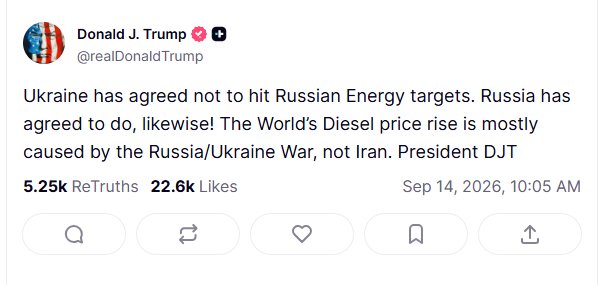
On September 14, Donald Trump announced via Truth Social that Russia and Ukraine had agreed to stop hitting each other's energy infrastructure. It was framed as a diplomatic win — a first step toward de-escalation that would also, conveniently, relieve record-high diesel prices in the United States ahead of November's congressional elections.
Within twenty-four hours, Russia launched approximately 200 drones at Ukraine. Petrol stations in Kyiv burned. Energy and port infrastructure across the country was hit. People were killed. Meanwhile, Ukraine struck an oil refinery in Syzran, Samara Oblast, and targeted drone production facilities in Taganrog and the Oryol region.
No formal agreement had been signed. Neither side had confirmed a ceasefire in any official capacity. The Kremlin called the proposal "a very good idea." President Zelenskyy said Ukraine was open to the idea — if the United States could guarantee that Russia would actually comply.
The truce, in other words, existed primarily in the space between Trump's post and the next missile launch.
Trump's Energy Truce With Russia: Domestic Price Politics Dressed as Diplomacy
The first thing to understand about Trump's energy truce proposal is what is driving it.
U.S. diesel prices crossed $6 per gallon in September 2026 — a record, and a politically toxic one. Trump has publicly and repeatedly linked this spike to Ukrainian drone strikes on Russian oil refineries, arguing that the campaign is disrupting global fuel supply chains and passing the cost to American consumers and trucking companies.
That framing is contested by market analysts, who point to broader pressures including Middle Eastern supply disruptions. But the political logic is straightforward: Trump needs a visible win on energy prices before November, and an energy truce — real or symbolic — gives him one.
What makes this position internally unstable is the simultaneous movement in Congress. The Lindsey Graham Sanctioning Russia and Iran Act of 2026, which passed the Senate 86–11 in August, would authorize the President to impose tariffs of up to 100% on any country purchasing Russian oil — a provision aimed squarely at China and India. Trump holds a sanctions sledgehammer in one hand and an olive branch in the other. These two postures have not been reconciled, and they signal to both Moscow and Kyiv that the American position is driven by short-term domestic calculus rather than strategic coherence.
For Trump, the energy truce is an instrument of price management. It is not, primarily, a peace initiative.

Why Russia Welcomes the Energy Ceasefire — On Its Own Terms
The Kremlin's response to Trump's announcement was carefully calibrated. Russia welcomed the proposal as "a very good idea" — but immediately attached conditions: the lifting of Western sanctions, guaranteed safety for maritime oil shipments, and the removal of what Moscow calls "unlawful restrictions" on Russian energy exports.
These are not minor procedural requests. They go to the heart of the economic architecture of the war.
Behind the maritime shipping demand lies the shadow fleet question. Roughly 600 tankers operate in a legal grey zone, moving Russian crude outside Western insurance and regulatory frameworks. Moscow has faced sustained pressure — diplomatic, financial, and now legislative, through the Graham Act — to shut these routes down. An energy truce that implicitly legitimizes these shipments would be a significant economic victory for Russia, achieved not through military success but through diplomatic packaging.
More importantly, Russia's condition sequence is structurally incompatible with the Western position. Moscow wants sanctions relief before any demonstrated compliance with a truce. The West — including the U.S., at least in its Congressional posture — treats sanctions as leverage to be preserved and applied after behavior changes. This is not a gap that can be bridged by goodwill. It requires one side to fundamentally change its negotiating logic.
Russia has no incentive to formalize commitments under current conditions. Staying "in principle supportive" without binding obligations is the optimal posture: it preserves diplomatic goodwill with Washington while maintaining operational flexibility on the battlefield.
Ukraine's Conditions for an Energy Strike Ceasefire: Verification or Nothing
Ukraine's position is the most structurally coherent of the three — and the most demanding.
President Zelenskyy has not rejected the idea of halting energy strikes. What he has rejected is the idea of doing so unilaterally, on the basis of a verbal commitment from Moscow that carries no enforcement mechanism.
The reason is straightforward: Ukraine's long-range drone campaign against Russian oil infrastructure is not a peripheral tactic. It is one of the most effective strategic tools Kyiv currently possesses. The campaign has reportedly damaged a significant share of Russia's refining capacity, degrading both the fuel supply available to Russian military logistics and the budget revenues that fund the war machine. To halt this campaign without receiving a guaranteed, verifiable halt to Russian strikes on Ukrainian power grids, heating systems, and civilian infrastructure would mean surrendering a major lever of pressure in exchange for a promise.
Ukraine has seen this movie before. The pattern of previous ceasefire attempts — the 30-day proposal of March 2025, the summer 2025 negotiation rounds — was consistent: declaration, continued strikes, mutual accusations of violations, diplomatic deadlock. Each time, the absence of a monitoring mechanism meant that the first violation, real or alleged, dissolved whatever goodwill had been built.
Zelenskyy's ask is not a veto on peace. It is a demand for architecture: a credible mechanism through which American guarantees translate into Russian compliance. That mechanism does not currently exist.
Energy Ceasefire and Military Balance: Why a Pause Could Favor Russia
Here is the part of this story that is not getting enough attention.
If a pause on energy strikes does materialize — even informally, even imperfectly — it will not affect both sides equally. The asymmetry runs deep, and it runs in Russia's favor.
Russian oil refineries have absorbed significant cumulative damage over the past year of Ukrainian drone operations. A pause in strikes is, for Russia, an opportunity to repair that damage — to restore refining capacity, rebuild budget revenues, and consolidate the economic foundation of a prolonged war. Russia has the capital, the domestic industrial base, and the relative insulation from Western supply chains to execute that restoration within weeks to months.
Ukraine's situation is the inverse. Years of systematic Russian strikes have left the country's energy grid in a state of chronic degradation. Repairing it requires not just a pause in new attacks — it requires massive inflows of specialized Western equipment, transformers, turbines, and grid components that depend on international procurement timelines measured in months. A truce does not unlock that supply chain.
The recovery gap is not symmetric. And that asymmetry has direct military implications. Russia emerges from a pause with more refining capacity, more oil revenues, and potentially replenished missile and drone stockpiles. Ukraine emerges from the same pause without a reliably functioning power grid and without the Ukrainian strikes that had been degrading Russia's war economy.
Historically, Russia has used pauses — humanitarian corridors, ceasefire windows, negotiation periods — to reposition forces and restock munitions. There is no structural reason to believe an energy truce would be different.
The war may freeze at the level of refineries and substations before it freezes at the front line. But that kind of freeze is not neutral. It is a strategic interval, and it favors the side that can use it more effectively. Right now, that is not Ukraine.
Russia-Ukraine Energy War Scenarios: What Happens Next
Three trajectories are realistically in play.
Scenario One: Truce on Paper. Both sides publicly accept the principle of halting energy strikes while redefining their ongoing operations as targeting "military" rather than "energy" infrastructure. The U.S. claims a diplomatic success. No verification mechanism is created. Within two to three weeks, the situation returns to the pre-announcement status quo — except that Trump has extracted a news cycle of progress coverage, and Russia has bought time without making concessions.
This is the most likely outcome, consistent with the pattern of every previous attempt at a localized ceasefire in this conflict.
Scenario Two: Asymmetric Pause. Under sustained pressure from Washington — tied perhaps to military aid conditionality or diplomatic isolation — Ukraine agrees to halt refinery strikes while the truce framework remains unverified. Russia continues to attack Ukrainian infrastructure at a reduced tempo, exploiting definitional ambiguity. Within 60 to 90 days, Russian refining capacity recovers partially. Ukraine's power grid does not. The balance of economic pressure shifts quietly and without a dramatic announcement.
This is the scenario that should concern Western policymakers most — precisely because it could unfold without anyone formally acknowledging that it had.
Scenario Three: Verification Architecture. The United States introduces a credible enforcement mechanism: satellite monitoring, diplomatic observers with authority to document violations, and automatic sanctions triggers tied to confirmed breaches. Violations carry immediate, pre-agreed consequences rather than diplomatic complaints. Both sides have a symmetrical incentive to comply because the cost of defection is defined in advance.
This is the only scenario in which a truce serves both parties' stated interests. It is also the scenario that requires the most from Washington — sustained political will, allied coordination, and a willingness to apply pressure on Moscow rather than simply on Kyiv. There is no current evidence that this will is present.
The United States holds the levers. Sanctions conditionality, military aid terms, diplomatic engagement in both Moscow and Kyiv — Washington could construct a credible enforcement framework if it chose to. But doing so would require applying pressure on Russia in ways that conflict with Trump's domestic economic interests, his preference for transactional engagement with the Kremlin, and his aversion to anything that reads as escalation.
What is left is a headline truce in a continuing war — one where energy infrastructure may become the first domain to see a partial, informal freeze, not because the parties have agreed, but because neither side wants to be seen as the one that rejected the idea.

