
August 21, 2026 - Freedom Person
It's a Saturday morning. Your kid is on the couch, wrapped in a blanket, eyes fixed on the screen.
On Netflix, a little girl in a red headscarf is chasing a bear around a snow-covered forest. There's slapstick. There's laughter. The animation is clean, the colors are warm, the music is bouncy.
You're in the kitchen making coffee.
Everything is completely normal.
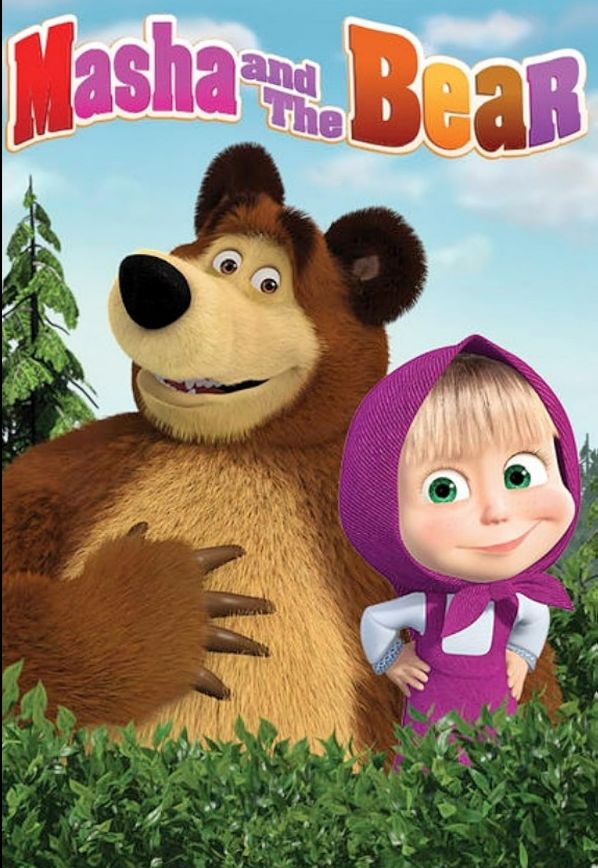
On August 20, 2026, Ukrainian President Volodymyr Zelensky signed a sanctions order against several people and a company connected to that cartoon. The targets include the Russian animation studio Animaccord, producer Dmitry Loveyko, and animator Oleg Kuzovkov, along with others involved in the show's production. The sanctions are set to last ten years and include measures that effectively block the distribution of the series inside Ukraine.
The accusation is extraordinary for a children's program. Ukrainian authorities have treated Masha and the Bear as a vehicle for pro-Russian narratives — a piece of Russia's broader cultural influence disguised as entertainment for toddlers.
A cartoon. A national-security issue.
Before you laugh — or before you agree — it's worth sitting with this for a moment. Because this story is not really about Ukraine, Russia, or even Masha and the Bear. It's about something much bigger: how cultural influence works when nobody experiences it as influence at all.
The Show You Probably Didn't Know Was Russian
Here's what many people in the West may not realize.
Masha and the Bear is not some regional curiosity that happened to escape Russia's borders. It is one of the most successful children's television franchises in the world — by any objective measure.
In 2023, Parrot Analytics named it the most in-demand children's show on the planet, after analyzing global audience data across more than 1,300 children's programs. In 2024, the series went further still, peaking in the top 10 most in-demand television shows worldwide across all categories — not just kids' programming. Among children's shows specifically, it held the number-two position globally throughout the 2020s, behind only SpongeBob SquarePants.
And this is not a show confined to Russian-speaking audiences.
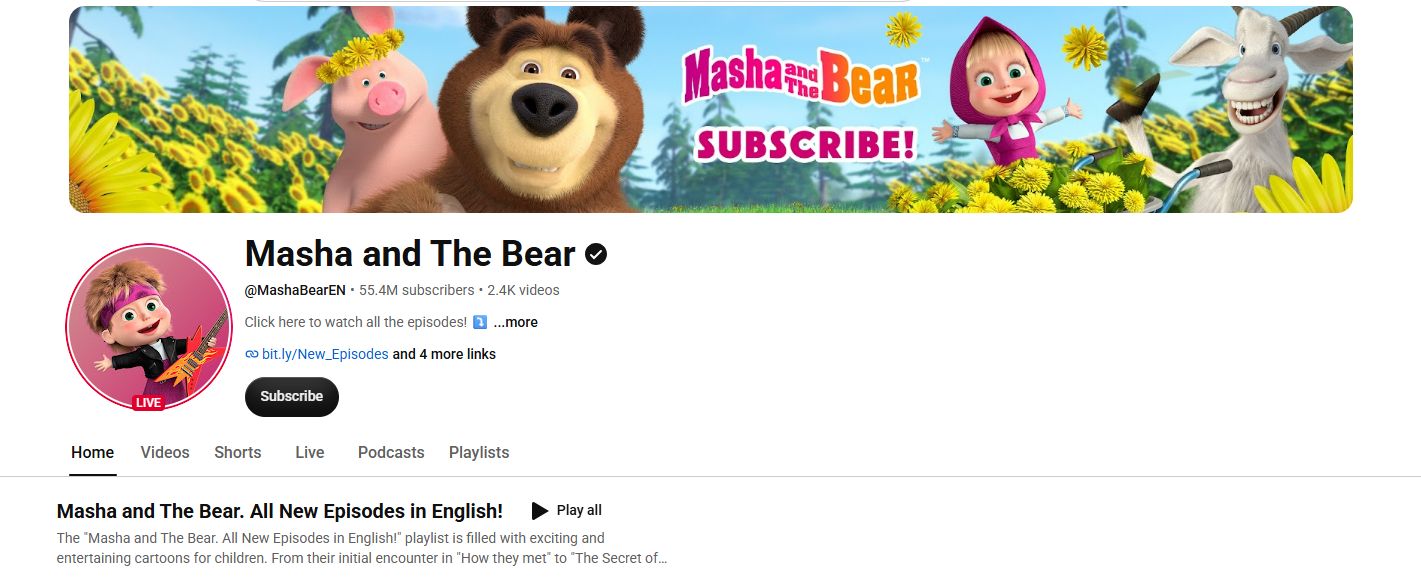
The official English-language YouTube channel has 55 million subscribers.
Netflix currently carries Masha and the Bear in the United States. In June 2026 — just two months before the sanctions — Netflix acquired two additional seasons and extended its rights to the series and its spin-offs across more than 100 countries.
Your child may have watched it. In English. On American Netflix. Without having the slightest idea that it was created by a Russian studio.
That is where this story gets interesting.
The Invisible Hand: What Soft Power Actually Means
In 1990, Harvard political scientist Joseph Nye popularized the concept of soft power — and the distinction he drew remains useful today.
Hard power relies on coercion: military force, economic pressure, sanctions. Soft power works through attraction — through culture, values, ideas, and the images a country projects to the outside world. The United States didn't need to tell the world that American life was worth wanting. Hollywood, pop music, and consumer culture made that argument quietly and continuously, for decades, without anyone framing it as a foreign-policy tool.
But here's the critical distinction Nye himself drew: being popular is not the same thing as being propaganda. And soft power is not automatically a deliberate instrument of the state.
A Russian cartoon can become a global hit without having been designed as a geopolitical weapon. That is precisely what makes Masha and the Bear such a genuinely difficult case — and why dismissing Ukraine's concerns too quickly may be a mistake.
Why Some Governments See More Than a Cartoon
The accusations against the show didn't appear out of nowhere.
In the months before the Ukrainian sanctions, more than 50 British MPs from multiple parties had already called for the cartoon to be removed from British broadcasting, citing concerns that it could function as Russian soft power. Among their specific complaints: episodes in which Masha appears dressed in Soviet-style military or secret-police imagery.
Critics have also pointed to the Bear himself. A bear is one of the most enduring symbols associated with Russia. In the series, however, he is not threatening. He is gentle, patient, competent, and warm. No child watching the show is told anything about Russia. But they do spend hours with a character that, consciously or not, carries cultural associations.
That doesn't prove the show was designed as propaganda. But it illustrates the mechanism that worries critics. A child doesn't need to hear "Russia is good." A child only needs to grow up with an image of Russia that feels familiar, harmless, and safe.
That is a very different kind of influence. And it is much harder to measure — or to prove.
America Has Been Here Before
This is where the story becomes uncomfortable for an American reader.
The United States has its own long history of using popular entertainment in support of national objectives — and some of it was aimed directly at children.
During World War II, American animation studios produced openly political material. Disney's Der Fuehrer's Face turned Donald Duck's nightmare of life in Nazi Germany into an anti-Nazi comedy. Education for Death, also from Disney, dramatized the psychological conditioning of a child into the Hitler Youth. Several of these films were produced in direct cooperation with the U.S. government as part of the broader wartime effort to shape public opinion. No one watching them today would mistake them for neutral entertainment.
But cultural influence doesn't always announce itself so clearly.
Consider Top Gun. The 1986 film was made with extensive cooperation from the U.S. military — the Navy provided aircraft, personnel, and access, while the film presented naval aviation as thrilling, elite, and deeply attractive. The claim that the film caused a 500 percent surge in recruitment is disputed, but what is not disputed is that the Navy actively used the film's popularity for recruiting, and that it meaningfully shaped how a generation of young Americans thought about military service.
The point isn't that Top Gun was Pentagon propaganda. The point is that entertainment and national influence can overlap without becoming identical — and that Americans have generally been comfortable with that overlap when the culture doing the influencing is their own.
Two Realities, One Cartoon
June 2026: Netflix expands its Masha and the Bear deal to more than 100 countries, including the United States and Canada. New seasons are coming.
August 2026: Ukraine sanctions the people who made it.
Same cartoon. Same episodes. Two completely different realities existing at the same time.
In one reality, it is a successful preschool franchise distributed by one of America's largest streaming companies. In another, it is an element of Russian cultural influence serious enough to warrant a formal national-security response.
There is also a third reality worth naming: the creators themselves reject the characterization. Animaccord has described itself as an independent company and denied receiving Russian government funding.
That matters — because there is a meaningful difference between a government deliberately engineering propaganda and a cultural product that becomes a vehicle for national influence simply by carrying the culture from which it came. The first requires evidence of intent. The second can happen without any.
Netflix hasn't pulled the show. No Western government has asked them to.
Should they?
The Part Nobody Can Fully Answer
This is where the argument becomes genuinely difficult.
If Masha and the Bear does function as soft power, what exactly is the mechanism? Is it the Russian folklore the show draws on? The Bear as a cultural symbol? The Soviet imagery in specific episodes? The normalization of Russian cultural references for children who have no other frame of reference? Or simply the fact that millions of children around the world are forming their earliest impressions of a country through its most charming export?
There's no simple way to measure that. And that uncertainty cuts in both directions.
It would be irresponsible to declare the cartoon propaganda on the basis of its country of origin alone. But it would be equally naive to assume that culture cannot shape political perceptions simply because no one is delivering an explicit political message.
That is the paradox at the heart of soft power. The most effective cultural influence may be exactly the kind that never feels like influence at all.
Back to Saturday Morning
You're still in the kitchen. The coffee is ready.
From the other room, you can hear your kid laughing at something on screen. A bear fell down. A little girl got into trouble again. The music swells.
You pour your cup. You don't think about Joseph Nye, or the Pentagon, or Kyiv, or Russian cultural policy.
Why would you? It's a cartoon.
And that's precisely what makes the question so difficult.
A child sees entertainment. A government sees influence. Between those two views lies a problem that no one — in Washington, in Brussels, or in Kyiv — has yet found a clean way to solve: how much can culture shape the way we see the world before we're obligated to call it something more than entertainment?
By Roman Severin

