

Zelensky's Iranian Card: How Kyiv Is Trying to Keep Trump on Its Side
On July 25, Ukrainian forces struck an Iranian vessel in the Caspian Sea, killing a sailor. Kyiv said the ship was ferrying military cargo between Iran and Russia. Three days later, Volodymyr Zelensky sat down with Donald Trump in a closed-door Oval Office meeting, having already told the world, in a social media post issued just ahead of the visit, that Russia has been feeding Iran satellite imagery of US and Gulf military installations — images he said correlate closely with the timing of Iranian strikes on those same sites.
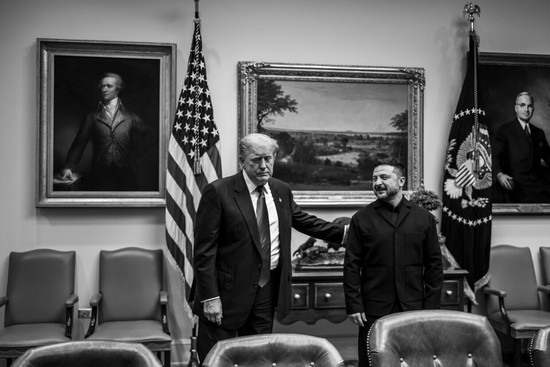
That sequence — a strike on an Iranian ship, a public accusation of Russia-Iran military cooperation, and a high-stakes Washington visit — is not a coincidence. It's a strategy. And it says a lot about where Kyiv believes it stands, four and a half years into a war, in its effort to keep the United States engaged.
What the "Iranian card" actually is
Stripped of the diplomatic language, the move is simple: Zelensky is trying to fuse Ukraine's war with Russia to America's own conflict with Iran, so that helping Ukraine looks less like an open-ended European entanglement and more like standing with an ally in a fight Washington is already fighting elsewhere.
The mechanics of the argument go like this. Iran has supplied Russia with Shahed-style attack drones for years — that part is well documented and uncontested. Zelensky's newer claim adds a second layer: that Russia is now returning the favor, passing along satellite reconnaissance of US and Gulf bases that Iran has then used to plan and assess its own strikes in its war with Washington. If true, it recasts Russia not as a distant, quasi-neutral actor in the Middle East but as an active participant helping a country currently at war with the United States.
That's a materially different pitch than "please keep funding our air defense." It's closer to: the same enemy you're fighting is helping the enemy we're fighting — this is one war, not two.
Analysts covering the story have noted exactly this framing shift — that the two conflicts are increasingly described, by Ukrainian officials and sympathetic commentators alike, as having "merged." Whether that's an accurate strategic assessment or a rhetorical device aimed at a specific audience in Washington is very much an open question, and it's one worth holding onto as the piece unfolds.
Why now
The timing isn't subtle. Trump's attention, by his own admission and by the visible priorities of his administration this year, has been consumed by the Iran war — airstrikes, a temporary pause for diplomacy, oil-price spikes, and a fragile off-ramp being negotiated in real time. Ukraine, by contrast, risks becoming background noise: a grinding, attritional conflict with no dramatic new headline, competing for a president's bandwidth against a shooting war involving the US military directly.
For Kyiv, the Iran card is a way to force its way back into the foreground without asking for anything new. It doesn't require a fresh weapons request or a change in US policy — it simply reframes the existing war in terms that map onto what Washington already cares about most right now. It also gives Ukraine's advocates in Congress — people who backed the Graham sanctions bill precisely because Lindsey Graham was a hawk on both Russia and Iran — a unifying argument rather than two separate ones.
The Business Case: Speaking Trump's Language
The Iran framing isn't the only way Kyiv is tailoring its pitch; there is also a distinct shift from asking for aid to proposing business. The closed-door Oval Office meeting was immediately followed by Zelensky sitting down with Lockheed Martin executives to discuss the co-production of Patriot interceptors.
Framing defense support as "co-production" speaks directly to Trump’s transactional worldview. It attempts to shift Ukraine from the "charity" column into the "investment" column, presenting defense cooperation as a driver for American manufacturing jobs and industrial base expansion rather than an endless drain on the US taxpayer. Even if experts warn that such joint ventures could take years to materialize, the rhetoric is calibrated specifically for a president who prefers making deals to writing checks.
What it leads to: risk and reward
The upside, if the strategy works, is real: continued Patriot cooperation, momentum behind the sanctions bill that cleared the Senate 86–12 shortly after the Graham funeral, and a US administration that stays invested in Ukraine's cause because it fits a broader "confronting shared adversaries" narrative rather than a standalone one.
The downside is that this is a genuinely risky escalation, not just a messaging exercise. Striking an Iranian vessel drew an immediate, public threat of retaliation from Iran's foreign minister, who framed the attack as being carried out "at Israel's behest" — which itself signals how easily this narrative can be read by others as Ukraine picking a side in a conflict that has nothing to do with its own survival. If Iran responds against Ukrainian or Ukrainian-linked targets, Kyiv has manufactured a second front it did not previously have, for the sake of a rhetorical argument aimed at one man in Washington. There's also a credibility risk: if the satellite-imagery claim is challenged or fails to hold up under scrutiny, it could undercut Zelensky's broader credibility with an administration that has, at various points, accused him of overstating his position.
Trump and Putin: does this help or complicate the picture?
Here the calculus gets genuinely ambiguous, and reasonable people read it differently.
One view: the Iran card is useful to Zelensky specifically because it gives Trump a reason to see Russia as untrustworthy without Zelensky having to re-litigate the war in Ukraine itself. Trump has spent months trying to broker something with Moscow — the Alaska summit, talk of "where we stand on the front line" as a ceasefire baseline — and Zelensky has had limited success arguing directly against that track. Painting Russia as an active enabler of Iran's war against American forces is a different kind of argument, one that doesn't ask Trump to abandon his Ukraine diplomacy so much as recontextualize Putin as untrustworthy on a completely separate, higher-stakes issue.
The opposing view: this could just as easily annoy Trump. He has invested real effort in the Iran off-ramp — pausing strikes specifically to give diplomacy a chance — and a storyline that complicates Russia's role in that conflict is not obviously something he wants layered on top of an already fragile negotiation. If Trump reads the Iran card as Zelensky trying to drag him deeper into the Middle East fight in service of Ukraine's own war, it could read as manipulation rather than alignment — and Trump has shown before that he reacts badly to a sense of being maneuvered.
Which of these dynamics is actually in play is not something that can be settled from the outside. What's notable is that both are plausible, and the ambiguity itself is probably part of why the meeting stayed behind closed doors.
Trump and the American public
Domestically, the optics cut in more than one direction too. Trump's own summary of the meeting — "Great Honor to meet with President Zelenskyy... Many things were discussed. The meeting went very well!" — was vague enough that even sympathetic commentary spaces reacted with mockery rather than approval, with some viewers reading the absence of specifics as a sign Trump himself isn't sure where things stand.
At the same time, there are signs the war has regained some traction with parts of Trump's own base. The story of Laura Loomer — a firebrand MAGA-aligned commentator who has spent years dismissing Ukraine's cause, only to travel there, witness Russian strikes firsthand, and publicly say she'd been "bamboozled by Russian propaganda" — is a small but telling data point. It suggests the administration's posture toward Ukraine isn't fixed, and that direct exposure to the war (or to Zelensky himself) can still move opinion inside Trump's own coalition. The bipartisan 86–12 Senate vote for the Graham sanctions bill points the same way: whatever fatigue exists, there is still a durable coalition in Washington willing to act against Russia.
None of this settles the broader domestic debate — there remains a real constituency, inside and outside Trump's base, that sees continued involvement in Ukraine as scope creep the US can't afford, especially while already engaged with Iran. The Iran card doesn't resolve that tension; it's aimed at Trump personally, not at the wider argument happening in American politics.
Behind closed doors: one speculative reading
Because the meeting was closed to press and the only public record is two brief, near-content-free statements from Trump and Zelensky, anything about the substance of the conversation is necessarily speculation. With that caveat firmly in place, one plausible — not confirmed — version of events might look like this:
Zelensky may have used the Iran material as his opening argument precisely because it doesn't require Trump to change his stance on peace terms with Russia — it only requires him to see Moscow as duplicitous on a matter separate from the war itself. In that reading, the "several other ideas that could help," a phrase both leaders used without elaboration, could plausibly include something like: continued or expanded intelligence-sharing on Russia-Iran cooperation, in exchange for firmer commitments on Patriot co-production timelines. It's also possible Trump used the moment to caution Zelensky against further strikes that risk widening the war — consistent with earlier reported warnings from the administration about targeting non-Russian vessels, after a Chevron-chartered tanker was hit near Novorossiysk.
Another version, just as plausible, is far less dramatic: that the meeting mostly covered exactly what was stated publicly — Patriot licensing, sanctions, diplomatic reinvigoration — and the Iran material was simply background context Zelensky had already put on the record beforehand, discussed only briefly rather than being the centerpiece.
Both readings are guesses. The honest answer is that outside observers don't know, and won't know, unless someone briefed on the conversation goes on record.
What it means going forward
Whatever was actually said in the Oval Office, the public strategy is now visible: Kyiv is betting that tying its war to Iran's war is a more durable way to hold Washington's attention than repeating the same appeals it has made for years. Whether that bet pays off depends on things well outside Zelensky's control — how the US-Iran conflict itself resolves, whether Trump's diplomacy with Putin advances or stalls, and whether Congress's appetite for sanctions survives contact with a White House that still seems to be improvising its Ukraine policy meeting by meeting.
The Iran card may buy Kyiv time, attention, and perhaps even some near-term defense contracts. But while it is a shrewd tactical pivot designed to keep Ukraine relevant in a distracted Washington, it remains an open question whether it buys durable leverage over the actual terms on which this war will ultimately end.
