
August 12, 2026 - Freedom Person
What a single tanker reveals about energy infrastructure as a weapon of war
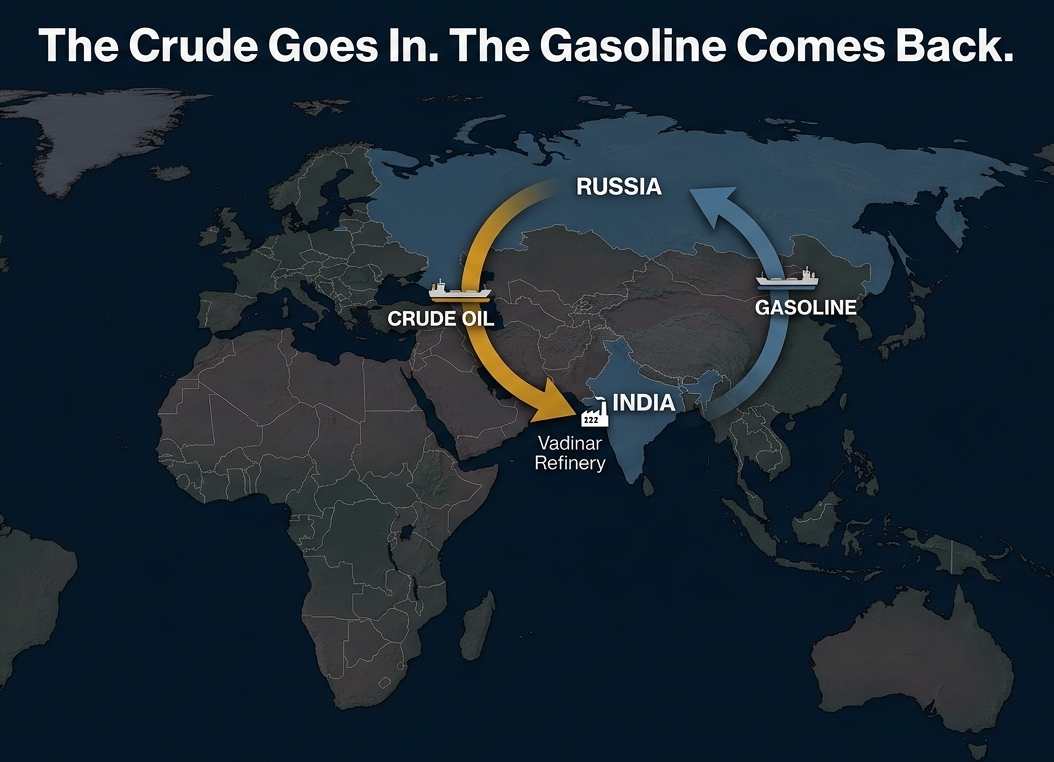
Russia just imported gasoline. Not crude oil — gasoline. The finished product, ready to pump. From a refinery in India.
For a country that sits on some of the world's largest hydrocarbon reserves, that sentence requires explanation.
The problem isn't the oil
Russia didn't run out of crude. That's not what this shipment signals.
The problem is what happens between the oil field and the gas station.
Crude oil is extracted, then refined — converted into gasoline, diesel, jet fuel and other usable products. That refining process requires physical infrastructure: plants, pipelines, processing capacity. And over the past year, Ukraine has been targeting precisely that layer.
The drone campaign against Russian oil refineries has received less attention than front-line military developments. It is unglamorous, incremental, and slow-moving. It doesn't produce the kind of images that dominate news cycles. But the data is starting to show results — and this shipment is one data point in that picture.
The Rosneft detail
Here's what makes the story stranger than a simple supply disruption.
The refinery that produced this fuel — Nayara Energy's Vadinar plant on India's western coast — is 49% owned by Rosneft, Russia's state oil giant. Russia didn't source this gasoline from a neutral third-party supplier. It drew from its own overseas asset, processed the fuel there, and shipped it home.
On June 18, the tanker Cyclone loaded roughly 42,000 tonnes of gasoline at Vadinar. In early July, the cargo was transferred to an Oman-flagged vessel called Garnet near the Egyptian port of Damietta. On August 6, it arrived in Russia.
The ship-to-ship transfer doesn't automatically prove sanctions evasion. But it is exactly what evasion looks like — and it adds a layer of opacity to a route that was already notable for what it reveals about Russian domestic supply.
What this does — and doesn't — mean
Precision matters here. This shipment does not mean Russia has run out of oil. It does not mean the Russian refining system has collapsed. Russia retains substantial crude production capacity, and its energy export infrastructure remains largely intact.
What it does mean is more specific — and more interesting.
Russia can have enormous crude reserves and still struggle to supply its own finished fuel market. Those are two different things. Reserves measure what's in the ground. Domestic fuel supply depends on what you can process, transport, and distribute. Degrade the processing layer — even partially — and you create real pressure on the domestic market, regardless of what's underground.
The infrastructure gap
This is the strategic insight that Ukraine appears to have grasped — and that Western commentary has been slow to fully articulate.
You don't have to destroy an adversary's oil fields to put pressure on their energy system. You can attack the infrastructure between the oil field and the gas station.
Refineries are large, fixed, and difficult to defend. They are also essential. Remove or degrade enough of that capacity, and a major oil producer finds itself in the paradoxical position of importing finished fuel — sourcing it from its own overseas assets, routing it through neutral jurisdictions, transferring it between vessels in international waters.
That is exactly what happened here.
The real headline
The 42,000 tonnes of gasoline that arrived in Russia on August 6 will not change the course of the war. It is one shipment, one data point, one piece of a much larger picture.
But data points have meaning. And this one says something worth sitting with.
Russia needed to import gasoline. Not because it ran out of oil. Because the infrastructure between the oil and the fuel is under pressure — and that pressure is being applied deliberately, systematically, and from the air.
The real headline isn't that Russia imported 42,000 tonnes of gasoline.
It's that Russia needed to.
By R. Severin

